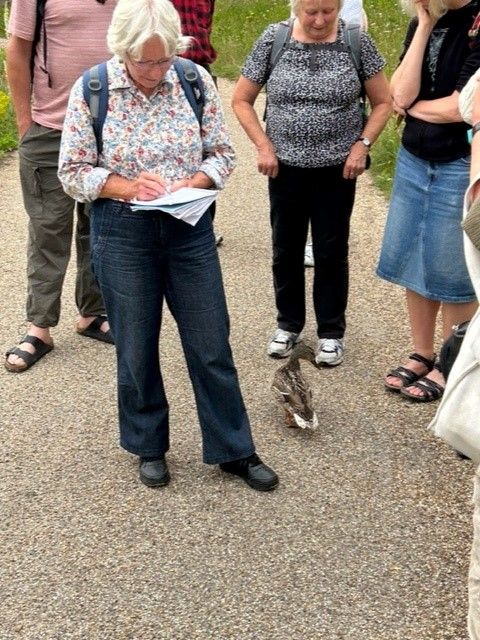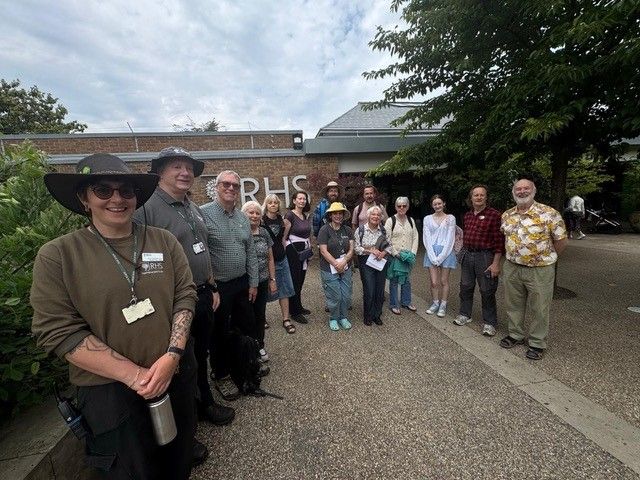
The purpose of the visit was to explore, learn about, and understand, the latest research on alternative, wildlife friendly, tree and shrub planting options for open spaces. The visit was led by Helen Bensted-Smith and Dr Nicholas Cryer. Helen is part of the gardens team and she led a tour of the Wildlife Garden and Clear Lake. Nick leads RHS’s research on the impact of more frequent drought conditions, along with future rainfall and water management options for open spaces.
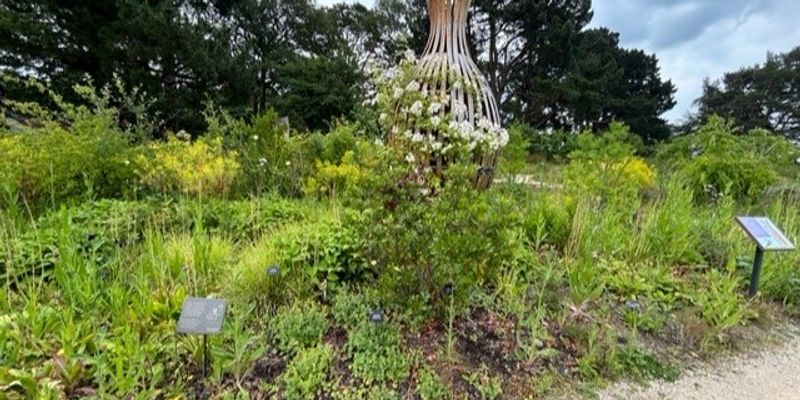
The approach they have adopted for the wildlife garden areas at Wisley is to create as much diversity as possible. Different areas of the garden are designed to achieve a number of outcomes: wildlife abundance; plant resilience; and human well-being.The impact of the Wellbeing Garden is assessed by visitors voluntarily taking part in a saliva test, which measures stress hormones present in an individual’s saliva.
Regular wildlife surveys are now being undertaken, but no baseline survey was undertaken as a comparator. Current wildlife abundance, however, is encouraging.
They experimented by planting a wide range of native, near native and non native species to assess the success of these plants, and their impact on the abundance of wildlife they attracted. They have focused on species with open flowers and shapes as these are the most insect friendly, and planted them in different styles and shapes, to avoid creating an area of monoculture. Most native plants are drought tolerant, but they have to create their own resilience to be successful and flourish on low nutrient ground.
There are a number of small meadows which are minimally mowed at different points in the year, to maintain a meadow rather than a lawn! This is to maximise species and encourage climate resilience, as the height of plant growth above the ground surface is indicative of root depth below the surface and hence resilience. Retaining taller grasses increases shade at ground level, which reduces surface temperature and improves resilience. Yellow Rattle, a native wildflower which is parasitic on grass roots, is encouraged as this weakens the grasses, allowing a range of wildflowers to become established. Long meadow grass is cut by scythe in July/August preferred to strimming as it produces a better result and is more environmentally friendly. Scything skills are easily learnt and not dangerous!!
In general any significant cutting back of dead plant material is only undertaken in March of each year, as many insect species overwinter amongst the dead material. Invasive species, such as brambles, are controlled by reducing fertility, by cutting and removing to increase the stress levels on these species.
A number of mounds have been planted with a variety of tree species. Bare root planting is preferred, to maximise the chance of growth and root spread. Ground cover is generally left to spontaneous growth.
They have created a number of ponds which they feel are critical to the success of wildlife areas. The ponds are not fish stocked, are allowed to vary their water depth naturally, including drying out. They carefully manage water nutrient levels, to keep this at a minimum as this is critical to pond health.
The visit then moved on to consider water and rainfall management. RHS Wisley has a number of surface storage ponds for irrigation. However, water loss through evaporation is significant - up to 30%. Underground storage options are, therefore, being assessed. There is also extraction from the River Wey, locally. Irrigation of the whole site is undertaken on a two weekly rotating cycle during periods of low rainfall.
RHS has been experimenting with low cost, small, reservoirs with stone filled void and non-permeable sides but a permeable surface. This allows rainwater to collect during wet periods and gives access by roots to water, by wicking, during drought periods. Once installed there has been no requirement for further irrigation. The trials are proving very successful.
Assessments have been undertaken of the overall water budget needs for RHS Wisley’s plant collections. This requires assessing individual plant take up, soil type and landscape influences, including the impact of tree cover, shade and cooling effects. This should enable future storage and extraction requirements to be more carefully budgeted and tailored to minimise water use but sustain healthy plant growth. It will also enable planting locations to be refined to minimise water take up requirements.
Finally, the tour visited the Science centre. This has been designed for public education, citizen science and professional science labs and research centre.The focus is on climate education and food supply. It features:
- climate change and impact on local environment across the UK.
- how to capture more water and how to look after it
- Herbarium, taxonomy and plant health.A particular feature is Darwin’s original potato plant pressing.
There is a strong focus on getting science out of the lab into real use in open spaces, including use by water companies.
If individual friends groups have particular irrigation/water management projects it is worth approaching the local water company to see if thy are prepared to offer grant funding assistance. Many of them now do this!
The three science labs cover entomology, plant health, disease identification and management, and impact of environmental changes. Pests and diseases change over time and through climate change. The lab advises on habitat risks for individual plant species. This lab is a ‘clean’ environment with separate field units for non-clean environment work.
Nick outlined a selection of current research, much of which is available on the RHS’s website using the ’science tabs’:
- Domestic plants water needs
- Soil analysis and sampling soil carbon microbiology
- Moving away from peat to other growth mediums. Plants do grow without peat! Current trials include use of coir, domestic and industrial compostables
- Matching new growth mediums to different plant species’ needs
- Sustainable drainage systems and reducing water to rivers
- Annual plant species’ water requirements and how to manage this over the whole year.
With many thanks to RHS Wisley, and thanks to Roger Jones for writing about the trip.